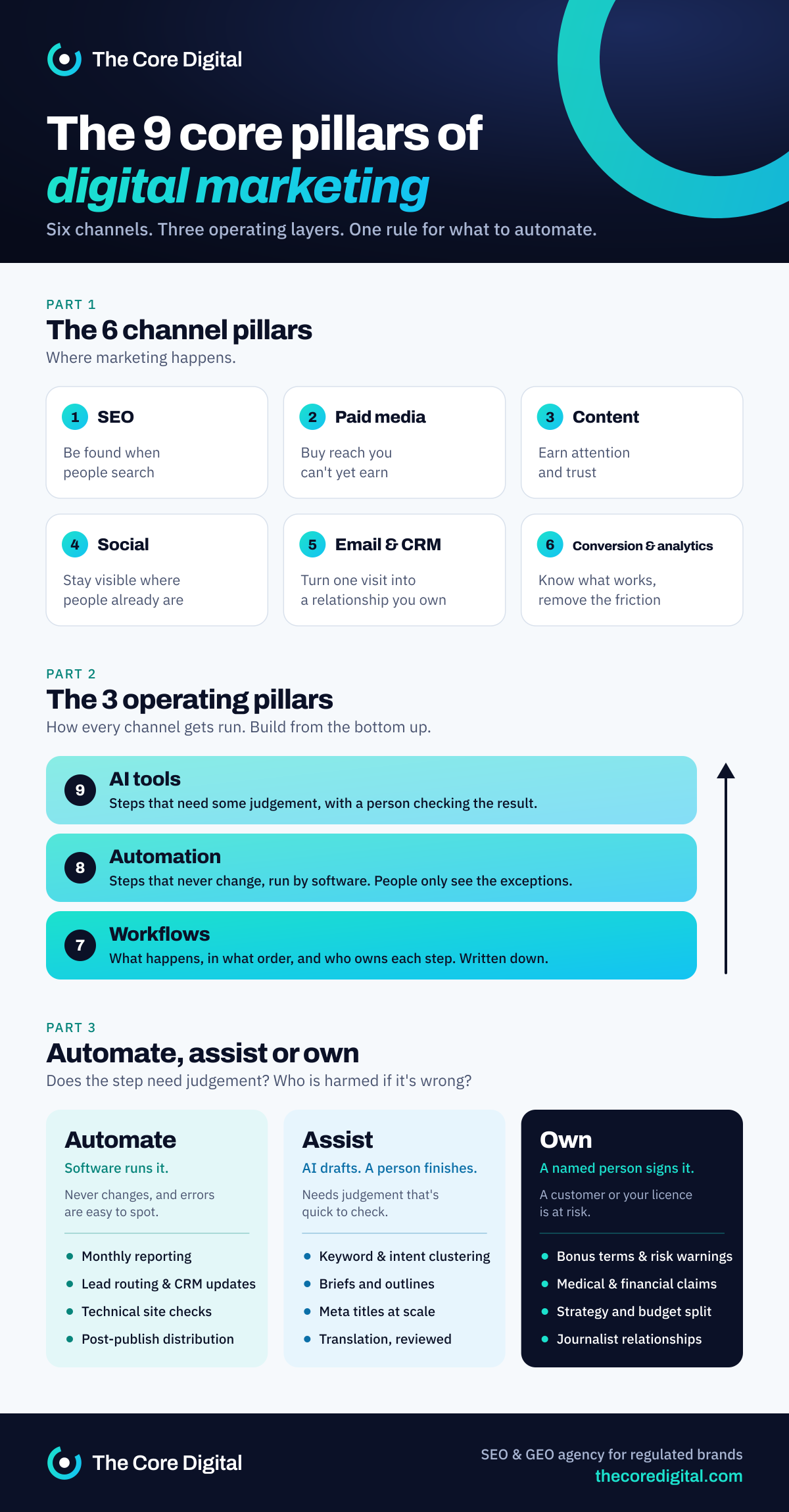
- The six channel pillars are SEO, paid media, content, social, email and CRM, and conversion and analytics.
- Three operating pillars sit underneath them: workflows, automation and AI tools.
- Sort every task into one of three lanes: automate, assist or own. Regulated wording and expert claims stay in the own lane.
- Do it in order. Write the workflow down, automate the steps that never change, then add AI where the result is quick to check.
- Almost every team now has AI tools. What separates them is whether the tool sits inside a written workflow.
Ask Google, or any AI assistant, for the core pillars of digital marketing and you'll get the same list back: SEO, paid ads, content, social, email, and conversion and analytics. I have no argument with it. Those are the channels, and most brands need most of them.
My problem is that the list would have been just as accurate in 2015. It tells you where marketing happens and nothing about how the work gets done, which is the part that has changed. Two teams can run the same six channels on the same budget and get very different results, because one has its process written down, its repeat tasks automated and its AI tools doing real work, and the other is copying data between spreadsheets.
So I count nine pillars: six channels, and three operating pillars underneath them. If you already know the channels, skip to the part that's hardest to find elsewhere: which tasks to automate, which to hand to AI and which to keep.
The six channel pillars
| Pillar | What it's for | What has changed |
|---|---|---|
| SEO | Being found when someone searches | Google answers more on the page, so ranking and being cited are separate goals |
| Paid media | Buying reach you can't yet earn | Platforms automate bidding; your inputs are creative, budget and conversion data |
| Content | Earning attention and trust | Generic articles cost nothing to make, so original data and expert review are what stand out |
| Social | Staying visible where people already are | Feeds favour individuals over brand accounts |
| Email and CRM | Turning one visit into a relationship you own | Lifecycle triggers matter more than send volume |
| Conversion and analytics | Knowing what works and removing friction | Fewer clicks reach your site, so you track visibility and assisted revenue too |
You don't need all six at full strength. A brand with restricted ad inventory, which covers most of gambling, trading and prescription health, leans much harder on the earned channels: search, content, PR and reputation.
The three operating pillars
These aren't channels. They're how every channel gets run.
Workflows. A workflow is the written answer to "what happens, in what order, and who owns each step?" Brief, draft, expert review, compliance sign-off, publish, distribute, measure. In regulated markets the review steps matter most: if a medical reviewer or compliance officer has to approve a page, that approval is a step with a named owner and a time limit, and nothing publishes around it. Workflows come first because you can't automate a process nobody has written down.
Automation. Software doing the workflow steps that never change. A form submission creates a CRM record and alerts the right person. A ranking drop on a tracked page opens a ticket. A published article is queued for social and the newsletter and logged in the reporting sheet. Tools like Zapier, Make and n8n connect the apps you already use.
AI tools. These handle the steps that need some judgement: summarising a call, clustering a few thousand keywords by intent, drafting a brief, checking a page against a style guide.
Having the tools is no longer what sets a team apart. In Glossy's annual survey of 142 brand and agency marketers, the share whose companies invest in AI rose from 44% in 2022 to 86% in 2025, and 85% use tools off the shelf rather than building their own (Glossy). Social Media Examiner's July 2026 survey of 681 marketers found AI involved in more than half the work of 32% of them (Social Media Examiner). In a smaller Digiday survey from early 2026, 49% were using AI in social campaigns (Digiday). What separates teams now is whether the tool sits inside a workflow, with a defined input, a defined output and a person checking the result, or whether it's a chat window everyone uses differently.
AI is also a channel question. Your buyers now ask assistants what they used to type into Google, and being the brand those answers cite is its own discipline, which we cover under AI visibility.
Automate, assist or own: a task-by-task split
Most advice on automation and AI stops at "use them where it makes sense". That isn't much help on a Monday morning, so here is the split I'd use for a brand in a regulated market. Two questions decide where a task goes.
- Does the step need judgement? If it never changes, automate it.
- Who is harmed if it's wrong? If the answer is a customer or your licence, a named person owns the final version, whatever produced the draft.
That gives three lanes. Automate: software runs it, and a person only sees the exceptions. Assist: AI produces a first version, and a person checks and finishes it. Own: a person does it and signs it, with AI limited to research and proofreading.
| Task | Lane | Why |
|---|---|---|
| Rank, traffic and conversion reporting | Automate | Same pull every month; errors are easy to spot |
| Lead routing and CRM updates | Automate | Rule-based, and delays cost money |
| Technical checks: broken links, redirects, hreflang, schema | Automate | A crawler finds these faster than a person |
| Distribution after publish: social, newsletter, internal links | Automate | Same steps for every piece |
| Keyword clustering and search-intent tagging | Assist | Fast to produce, quick to sanity-check |
| Content briefs and outlines | Assist | AI gathers and structures; a strategist decides the angle |
| Meta titles and descriptions at scale | Assist | Low risk per page, but review samples for claims |
| Translation and localisation | Assist | Machine output needs a native reviewer who knows that market's rules |
| Replies to reviews and complaints | Assist | Drafts save time; tone and admissions need a person |
| Bonus terms, odds, fees and risk warnings | Own | Regulated wording; a wrong number is a breach |
| Medical, financial or legal claims | Own | Needs a qualified reviewer whose name goes on the page |
| Strategy, positioning and budget split | Own | The decision is the job |
| Journalist and partner relationships | Own | People can tell, and a relationship isn't a template |
The lanes aren't fixed. A task moves from Own to Assist once you've written down what a good result looks like, and from Assist to Automate when the checks stop finding anything. They also move back: when a regulator changes a rule, everything touching that rule returns to Own until the workflow is updated.
In an unregulated market I'd shift most of the Assist rows one lane towards Automate. The Own rows are where regulated brands differ, and they're why "let the AI publish it" isn't an option here.
To run this for your own team, download the template (CSV, opens in Excel or Google Sheets). It has the thirteen tasks above with columns for owner and check, and blank rows for your own.
One piece of content, start to finish
- Workflow: the brief template asks for the target query, the search intent, the expert reviewer and the compliance rules for that market.
- Assist: an AI tool pulls the top-ranking pages, lists the questions they answer and drafts an outline against the brief.
- Own: a writer with real subject knowledge writes it. A named expert reviews it. Compliance signs it off.
- Automate: publishing triggers the social posts, the newsletter slot, the internal-links check and a row in the reporting sheet.
- Assist: thirty days later, AI compares rankings, AI citations and conversions against the brief and flags what to update.
Where to start
- Write the workflow down. Pick your most repeated job, usually content production or monthly reporting, and list every step and owner. Doing this usually shows you the bottleneck.
- Automate the handoffs. Start where work waits for someone to notice it: notifications, record creation, status updates.
- Add AI where checking is quick. Use it first on work a person can verify in a minute. Leave final claims and anything a regulator might read to people.
- Measure the process too. Time from brief to publish, and the share of work that needed redoing, tell you more about next quarter than this month's sessions do.
The mistake I see most often is starting at step three. A team buys AI tools, points them at a process nobody has defined and gets faster at producing work that still has to be redone. Automating a broken process only gets you the wrong result sooner.
Quick answers
What are the core pillars of digital marketing?
Six channels: SEO, paid media, content marketing, social media, email and CRM, and conversion and analytics. Three operating pillars decide how well those channels perform: workflows, automation and AI tools.
What's the difference between marketing automation and AI in marketing?
Automation runs steps that never change, such as routing a lead or sending a report. AI handles steps that need some judgement, such as drafting a brief or grouping keywords, and its output needs a person to check it.
What should you not automate in regulated marketing?
Anything where a mistake harms a customer or puts a licence at risk: bonus terms, odds, fees, risk warnings, and medical, financial or legal claims. AI can help with research and proofreading, but a named, qualified person writes or approves the final version.
Where should a marketing team start with AI?
With a written workflow, not a tool. Document one repeated process, automate its handoffs, then add AI to the steps where a person can verify the result in about a minute.
The whole thing on one page
If you'd like help mapping your own channels and workflows, get in touch.
See how our Content marketing team works with regulated brands.